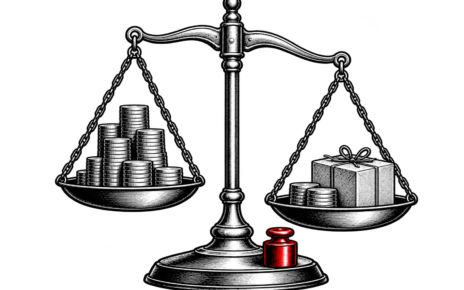

A campaign brings in 200 new customers. Before you increase the budget, answer two questions: what did those customers cost to acquire, and how much value will they contribute?
A loyal customer who stays for 14 years can be valuable, but may be a misleading example of what a typical customer is worth. Start with customer records, compare groups, and check whether a few unusually loyal customers are skewing your assumptions.
Start with acquisition cost
Customer acquisition cost, or CAC, is acquisition spending divided by new customers acquired. Match the spending, customers, and period. Include relevant creative, media, sales, and other acquisition expenses.
Consider a hypothetical mailing campaign. A $2,400 mailing reaches 10,000 people and produces 200 new customers. Each redeems a $7 introductory coupon.
- Mailing cost: $2,400
- Redeemed coupons: 200 × $7 = $1,400
- Total acquisition spending: $3,800
- Campaign CAC: $3,800 ÷ 200 = $19
This assumes $2,400 covers all other acquisition costs. Count coupons when redeemed. Treat the $7 coupon as a cost for each customer who redeems it, rather than for every person who receives the mailing.
If you include a coupon in CAC, avoid subtracting it again from the customer contribution below. Use a consistent treatment of discounts throughout your records.
Calculate the contribution a customer can generate
For a simple planning estimate:
Value after acquisition = average order value × orders per year × customer years × contribution margin before acquisition − CAC
Contribution margin is the share of revenue left after variable costs of serving those sales, such as products, fulfillment, payment processing, and variable service costs. Acquisition costs are subtracted separately in this model. Shopify’s acquisition guide explains why margins matter when evaluating acquisition spending.
Take a separate hypothetical example, matching the calculator in Resources: a $100 average order, three orders per year, two customer years, a 60% contribution margin before acquisition, and $40 CAC.
- Revenue over the assumed period: $100 × 3 × 2 = $600
- Contribution before acquisition: $600 × 60% = $360
- Contribution after acquisition: $360 − $40 = $320
The $320 still needs to help cover fixed overhead and company profit. It is not net company profit. Treat the assumed two years as a projection unless you have completed purchasing records for that period.
Separate observed history from a forecast
Group customers by acquisition month or quarter, then compare their contribution after the same amount of time. Customer cohort reporting illustrates grouping customers around their first purchase.
A three-month-old customer group has had fewer chances to buy than a three-year-old group. Compare like periods and examine both averages and the distribution of results. A few very large or long-lived customers can obscure what normally happens.
For longer forecasts, account for uncertainty and the timing of future cash flows. Customer-base research by Fader, Hardie, and Shang distinguishes observed purchasing from modeled future transactions. The simple calculator is a starting point for planning, not a forecast guarantee.
Use customer value to improve the business
- Improve the second purchase. Look for problems with onboarding, delivery, service, or the next step.
- Make relevant offers. A refill, service extension, or complementary product should add contribution after its costs.
- Compare customer sources. Low acquisition costs can hide weak repeat purchasing or expensive service needs.
- Watch payback. A valuable customer may still take longer than your cash position allows to repay acquisition spending.
Projected contribution is not permission to spend the full amount on acquisition. Leave room for overhead, profit, uncertainty, and cash flow. Update your assumptions as actual purchases develop.
Use the free customer value calculator to compare assumptions, or work with me to connect marketing spending with business results.